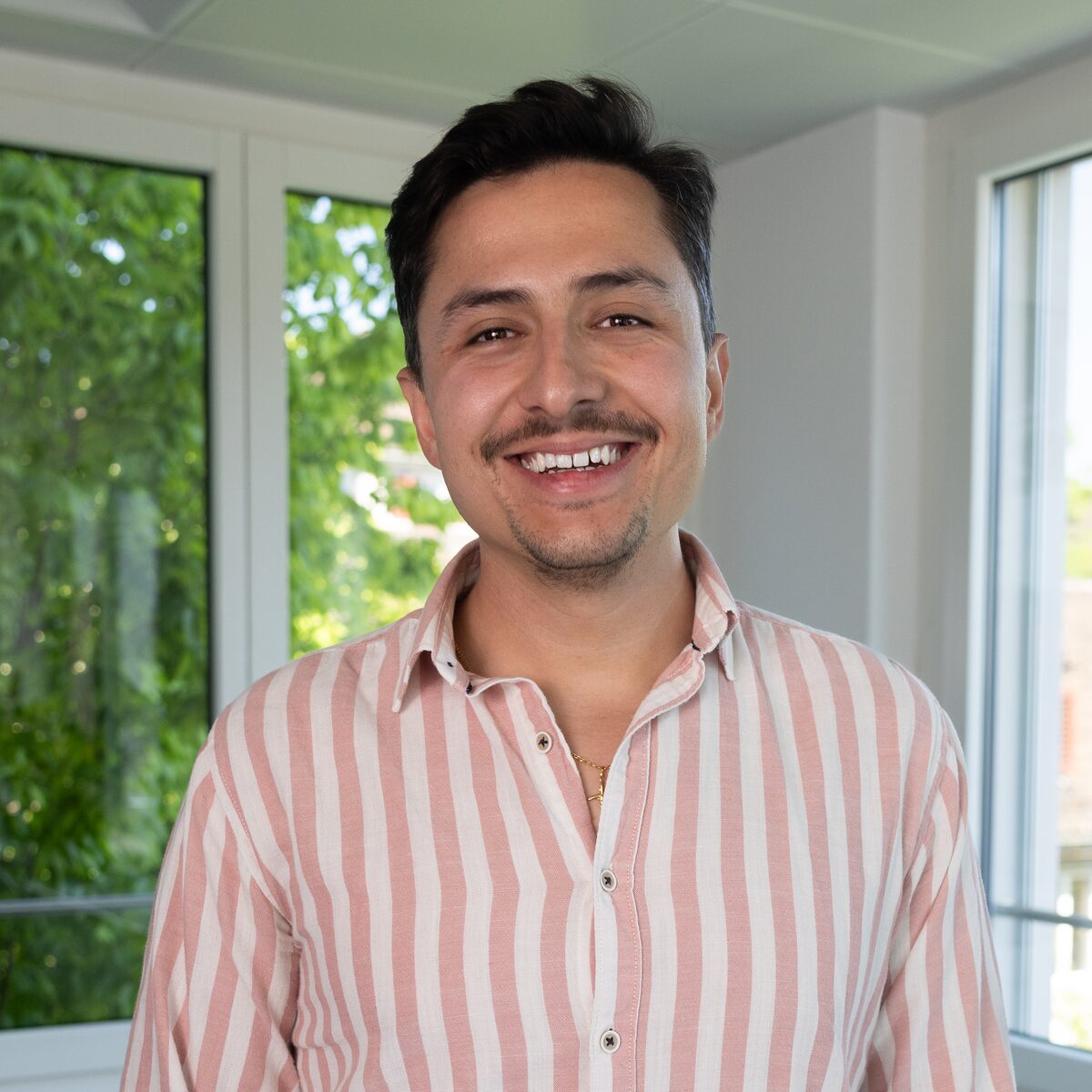
I build and deploy speech-and-audio LLMs, production ASR, and spoken language understanding systems.
PhD from EPFL & IDIAP. Previously at Apple and AWS.
I'm a Senior Research Scientist at Agigo AG, a Swiss AI company building autonomous AI agents.
My work sits at the intersection of natural language processing and automatic speech recognition, with a strong focus on speech-and-audio LLMs.
I completed my PhD at EPFL and IDIAP in 2024.
My thesis tackled automatic speech recognition for air traffic control, one of the hardest real-world ASR domains.
Along the way I built the ATCO2 corpus, fine-tuned self-supervised models for this domain,
and published work on speaker diarization, speaker role detection, and contextual ASR.
Before Agigo, I interned at Apple (ML for ASR on tail named entities) and
at AWS (speech translation and transcription).
I hold master's and bachelor's degrees in Mechatronics Engineering from Universidad de Oviedo and Universidad Autónoma del Caribe.
I live in Zürich. Originally from Baranoa, Colombia.
currently
High-throughput LLM & speech model serving:production deployment with vLLM-Omni: streaming decoders, CUDA Graphs, torch.compile, and multi-client inference scheduling.
TTS controllability & steering:conditioning generative TTS on prosody, speaker identity, and style, including voice cloning and zero-shot cross-lingual synthesis.
Full-stack model development:end-to-end: data curation, large-scale synthetic data generation, training optimization targeting 50% MFU, and deployment tuning for low-latency serving.
Local LLM deployment & KV-cache offloading:memory-efficient inference using disaggregated caching and offloading techniques (e.g., LMCache) for constrained-GPU and edge scenarios.
Holistic TTS evaluation pipelines:state-of-the-art automated evaluation covering intelligibility, speaker similarity, naturalness, prosody, and robustness across languages and domains.
Omni-modal data pipelines:large-scale processing with omni LLMs to generate multi-task RL training signal across speech, text, and audio.
engineering
I work across the full stack behind production speech and language AI, from low-level GPU kernels up to
high-concurrency serving. Deep systems knowledge paired with modern tooling lets me compress the loop from
idea to shipped system, and get outsized leverage from a small team.
CUDA & Triton kernel developmentTTS systems & controllabilityLLM & omni-modal inferenceHigh-concurrency deploymentLarge-scale data curationRapid prototyping & evaluation
GRAFT: Grafted Reference Audio for Fine-grained Pronunciation in Zero-shot Text-to-Speech
IEEE SLT2026
A. Asonitis, F. Verdini, A. Farhadipour, V. Avijeet, P.-E. Honnet, M. Razavi, J. P. Zuluaga.
Per-word pronunciation control for codec-LM TTS from a short spoken hint of the word, fixing rare names, loanwords, and technical terms in any target voice.
@inproceedings{graftgrafted2026,
  title = {GRAFT: Grafted Reference Audio for Fine-grained Pronunciation in Zero-shot Text-to-Speech},
  author = {A. Asonitis and F. Verdini and A. Farhadipour and V. Avijeet and P.-E. Honnet and M. Razavi and J. P. Zuluaga},
  booktitle = {IEEE SLT},
  year = {2026},
  url = {https://arxiv.org/abs/2607.02633}
}
The Limits of Reference-Free Speech Quality Metrics as Evaluators and Rewards on Modern Text-to-Speech
IEEE SLT2026
A. Asonitis, J. P. Zuluaga, F. Verdini, A. Farhadipour, M. Razavi, P.-E. Honnet, V. Avijeet.
UTMOS, DNSMOS and SCOREQ break down on modern defect-free TTS and invite reward hacking; a calibrated composite of metrics is a stronger evaluator and reward.
@inproceedings{thelimits2026,
  title = {The Limits of Reference-Free Speech Quality Metrics as Evaluators and Rewards on Modern Text-to-Speech},
  author = {A. Asonitis and J. P. Zuluaga and F. Verdini and A. Farhadipour and M. Razavi and P.-E. Honnet and V. Avijeet},
  booktitle = {IEEE SLT},
  year = {2026},
  url = {https://arxiv.org/abs/2609.13150}
}
Controlling Speaking Rate in Autoregressive TTS via Activation Steering
IEEE SLT2026
F. Verdini, A. Asonitis, A. Farhadipour, M. Razavi, P.-E. Honnet, V. Avijeet, J. P. Zuluaga.
@inproceedings{controllingspeaking2026,
  title = {Controlling Speaking Rate in Autoregressive TTS via Activation Steering},
  author = {F. Verdini and A. Asonitis and A. Farhadipour and M. Razavi and P.-E. Honnet and V. Avijeet and J. P. Zuluaga},
  booktitle = {IEEE SLT},
  year = {2026}
}
Unifying Global and Near-Context Biasing in a Single Trie Pass
TSD2025
I. Thorbecke, E. Villatoro-Tello, J. P. Zuluaga, S. Kumar, S. Burdisso, P. Rangappa, A. Carofilis, S. Madikeri, P. Motlicek, K. Pandia, K. Hacioglu, A. Stolcke.
Single-pass trie unifies global vocabulary biasing with utterance-level context biasing for transducer ASR.
@inproceedings{unifyingglobal2025,
  title = {Unifying Global and Near-Context Biasing in a Single Trie Pass},
  author = {I. Thorbecke and E. Villatoro-Tello and J. P. Zuluaga and S. Kumar and S. Burdisso and P. Rangappa and A. Carofilis and S. Madikeri and P. Motlicek and K. Pandia and K. Hacioglu and A. Stolcke},
  booktitle = {TSD},
  year = {2025},
  url = {https://doi.org/10.1007/978-3-032-02548-7_15}
}
Speech Data Selection for Efficient ASR Fine-Tuning
ICASSP2025
P. Rangappa, S. Madikeri, J. P. Zuluaga, J. Villatoro-Tello, P. Motlicek.
A domain classifier plus pseudo-label filtering cuts ASR fine-tuning compute by ~40% at matched WER.
@inproceedings{speechdata2025,
  title = {Speech Data Selection for Efficient ASR Fine-Tuning},
  author = {P. Rangappa and S. Madikeri and J. P. Zuluaga and J. Villatoro-Tello and P. Motlicek},
  booktitle = {ICASSP},
  year = {2025},
  url = {https://ieeexplore.ieee.org/abstract/document/10888138/}
}
XLSR-Transducer: Streaming ASR for Self-Supervised Pretrained Models
ICASSP2025
S. Madikeri, J. P. Zuluaga, P. Rangappa, J. Villatoro-Tello, P. Motlicek.
Streaming ASR atop a frozen self-supervised backbone, without sacrificing non-streaming accuracy.
@inproceedings{xlsrtransducer2025,
  title = {XLSR-Transducer: Streaming ASR for Self-Supervised Pretrained Models},
  author = {S. Madikeri and J. P. Zuluaga and P. Rangappa and J. Villatoro-Tello and P. Motlicek},
  booktitle = {ICASSP},
  year = {2025},
  url = {https://arxiv.org/abs/2407.04439}
}
Open-source Conversational AI with SpeechBrain 1.0
JMLR2024
M. Ravanelli, T. Parcollet, A. Moumen, S. de Langen, C. Subakan, P. Plantinga, Y. Liao, S. Cornell, D. Roman, S. Moradi, D. Chander, D. Petermann, Y. Wang, J. P. Zuluaga, et al.
Co-authored the 1.0 release of SpeechBrain, a PyTorch toolkit for conversational AI.
@article{opensource2024,
  title = {Open-source Conversational AI with SpeechBrain 1.0},
  author = {M. Ravanelli and T. Parcollet and A. Moumen and S. de Langen and C. Subakan and P. Plantinga and Y. Liao and S. Cornell and D. Roman and S. Moradi and D. Chander and D. Petermann and Y. Wang and J. P. Zuluaga and others},
  journal = {JMLR},
  year = {2024},
  url = {https://jmlr.org/papers/v25/24-0991.html}
}
@inproceedings{endto2023,
  title = {End-to-end single-channel speaker-turn aware conversational speech translation},
  author = {J. P. Zuluaga and Z. Huang and X. Niu and R. Paturi and S. Srinivasan and P. Mathur and B. Thompson and M. Federico},
  booktitle = {EMNLP},
  year = {2023},
  url = {https://aclanthology.org/2023.emnlp-main.493/}
}
HyperConformer: Multi-Head HyperMixer for Efficient Speech Recognition
Interspeech2023
F. Mai, J. P. Zuluaga, T. Parcollet, P. Motlicek.
Replaces Conformer attention with HyperMixer, matching accuracy at a fraction of the compute.
@inproceedings{hyperconformermulti2023,
  title = {HyperConformer: Multi-Head HyperMixer for Efficient Speech Recognition},
  author = {F. Mai and J. P. Zuluaga and T. Parcollet and P. Motlicek},
  booktitle = {Interspeech},
  year = {2023},
  url = {https://arxiv.org/abs/2305.18281}
}
CommonAccent: Exploring Large Acoustic Pretrained Models for Accent Classification
Interspeech2023★ Best Student Paper nominee
J. P. Zuluaga, S. Sarfjoo, A. Prasad, I. Nigmatulina, P. Motlicek, K. Ondrej, O. Ohneiser, H. Helmke.
Accent classification benchmark on Common Voice using large self-supervised models.
@inproceedings{commonaccentexploring2023,
  title = {CommonAccent: Exploring Large Acoustic Pretrained Models for Accent Classification},
  author = {J. P. Zuluaga and S. Sarfjoo and A. Prasad and I. Nigmatulina and P. Motlicek and K. Ondrej and O. Ohneiser and H. Helmke},
  booktitle = {Interspeech},
  year = {2023},
  url = {https://arxiv.org/abs/2305.18283}
}
How Does Pre-Trained Wav2Vec 2.0 Perform on Domain Shifted ASR? An Extensive Benchmark on Air Traffic Control Communications
IEEE SLT2022
J. P. Zuluaga, A. Prasad, I. Nigmatulina, S. Sarfjoo, P. Motlicek, M. Kleinert, H. Helmke, O. Ohneiser, Q. Zhan.
Systematic study of self-supervised pretraining under domain shift, 20–40% relative WER cut on Air Traffic Control.
@inproceedings{howdoes2022,
  title = {How Does Pre-Trained Wav2Vec 2.0 Perform on Domain Shifted ASR? An Extensive Benchmark on Air Traffic Control Communications},
  author = {J. P. Zuluaga and A. Prasad and I. Nigmatulina and S. Sarfjoo and P. Motlicek and M. Kleinert and H. Helmke and O. Ohneiser and Q. Zhan},
  booktitle = {IEEE SLT},
  year = {2022},
  url = {https://arxiv.org/abs/2203.16822}
}